Best Angular Frameworks For Modern Web Development
In today’s fast-paced digital world, developers need tools that offer efficiency, scalability and consistency. That’s where Angular frameworks shine out. As powerful extensions of the core Angular framework JavaScript, these tools simplify Angular for front end development. This makes complex applications more manageable. Right tools’ selection—from UI kits to data handling libraries—is critical to success. […]
logic
August 11, 2025

In today’s fast-paced digital world, developers need tools that offer efficiency, scalability and consistency. That’s where Angular frameworks shine out. As powerful extensions of the core Angular framework JavaScript, these tools simplify Angular for front end development. This makes complex applications more manageable. Right tools’ selection—from UI kits to data handling libraries—is critical to success. So today we are to offer guidance on picking the right Angular development tools.
Why Use Angular Frameworks?
Though the core Angular framework JavaScript is quite strong, regarding the feature, it doesn’t cover every need. To fill the gaps, developers often turn to specialized Angular frameworks or UI libraries. These tools provide reusable components, better styling and faster data handling.
Leveraging a strong Angular front end framework propels website development. These help you write less repetitive code. These also ensure your app looks and works the same way everywhere. Particularly required when working in large teams or enterprise-level projects. Let’s understand when to use a prebuilt framework versus when to build custom solutions.
- External Angular UI libraries offer greater speed
- Custom solutions are best for unique, brand-specific needs.
Beyond UI: Smart Tools Every Angular Dev Should Know
Apart from ready-made UI libraries, Angular also has powerful helper toolkits like Angular CDK (Component Dev Kit) that give building blocks for drag-and-drop, overlays, and accessibility without forcing a fixed design. Developers can also add state management tools like NGXS or NGRX, which make handling data easier in big apps, and internationalization libraries like NGX-translate to add multiple languages.
In 2025, developers are increasingly pairing Angular CDK with NG-Zorro (Alibaba’s Ant Design implementation for Angular) for global enterprise dashboards, or using Syncfusion Angular UI for 90+ enterprise-grade components like DataGrids, Scheduler, and PDF Viewer. Platforms like UI Bakery are also emerging, letting teams visually build dashboards and export clean Angular code—ideal for rapid prototyping.
Top 8 Angular Frameworks & Libraries:
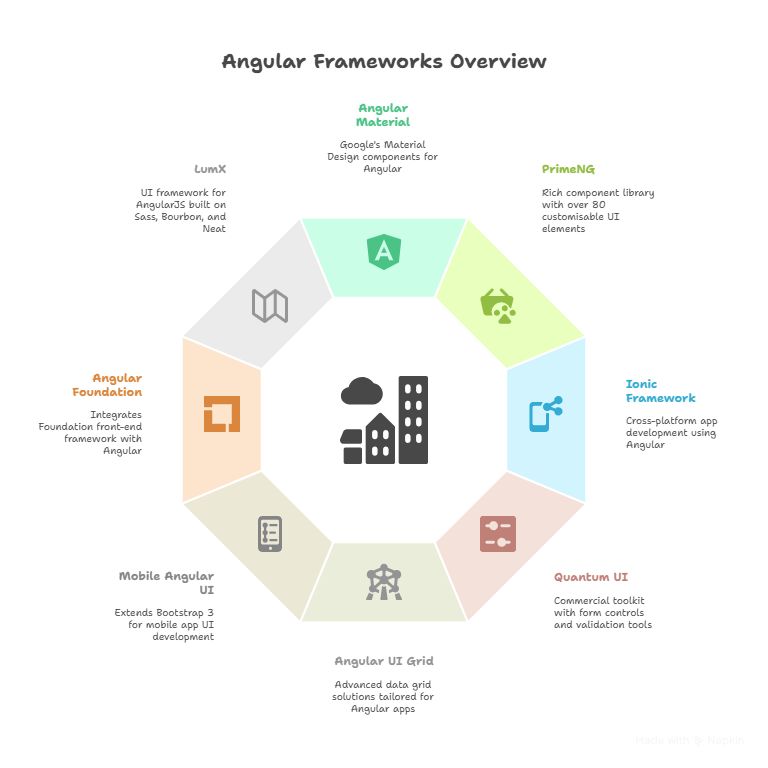
We are now sharing a thoughtfully, well researched curated list of the best Angular frameworks and UI libraries you should consider in 2025. Each tool has been selected for its relevance, performance and real-world uses.
1. Angular Material:
What It Does – Developed and maintained by the Angular team, Angular Material brings in Google’s Material Design components.
Key Features:
- Responsive and accessible components
- Theming and typography systems
- Deep integration with Angular CLI
Use Cases – Perfect for admin dashboards, eLearning platforms and healthcare UIs.
Useful For – This Angular front end framework drastically reduces UI development time while promoting design consistency. For many, it’s the go-to solution in Angular web development environments due to first-party support.
2. PrimeNG:
What It Does – A rich component library with over 80 customizable UI elements.
Key Features:
- Advanced DataTable, charts and dynamic forms
- Themes (including Material and Bootstrap lookalikes)
- Active community and commercial support
Use cases – Suited for enterprise apps, ERP systems and real-time dashboards.
Useful for – PrimeNG is one of the most complete Angular UI libraries, offering excellent support for complex interfaces. It blends well into any Angular web development workflow, especially when performance and UI richness are priorities.
3. Ionic Framework (for Angular):
What It Does – Enables cross-platform app development using Angular, HTML and CSS.
Key Features:
- Native-like mobile UI components
- Built-in PWA and Capacitor support
- Excellent mobile performance
Use Cases – Ionic Framework is Ideal for hybrid mobile apps, PWA (Progressive Web App)s and wearable device interfaces.
Useful For – If you’re using Angular for front end mobile apps, Ionic is unmatched. It bridges the power of web technologies with native app feel, all while being fully aligned with the Angular framework JavaScript ecosystem.
4. Quantum UI:
What It Does – A commercial toolkit with form controls, modals, validation tools and more.
Key Features:
- Highly customizable themes
- Comprehensive documentation
- Responsive design components
Use Cases – Excellent for SaaS platforms, HR management systems and eCommerce admin panels.
Useful For – For projects requiring fine-tuned control, Quantum UI stands out among Angular frameworks. It gives developers the flexibility needed for branded experiences in large-scale deployments.
5. Angular UI Grid:
What It Does – Offers advanced data grid solutions tailored for Angular apps.
Key Features:
- Column pinning, filtering and sorting
- Infinite scrolling and grouping
- Handles large datasets efficiently
Use Cases – Best for fintech dashboards, inventory systems and CRM tools.
Useful For – Among Angular development tools, UI Grid is essential for applications dealing with complex data. It works seamlessly with core Angular components to render dynamic, user-friendly tables.
6. Mobile Angular UI:
What It Does – Extends Bootstrap 3 and AngularJS for mobile app UI development.
Key Features:
- Mobile-optimized components like sidebars and navbars
- Touch gesture support
- Lightweight and easy to integrate
Use cases – Mobile Angular UI is Suitable for hybrid apps or maintaining legacy AngularJS-based apps. It was designed for Angular framework JavaScript (1.x), not Angular 2+.
Useful For – Still valuable for developers supporting legacy systems. It allows consistent mobile experiences without a complete rewrite using modern Angular UI libraries.
7. Angular Foundation:
What It Does – Integrates the Foundation front-end framework with Angular’s architecture.
Key Features:
- Responsive grid systems
- Modal windows, tabs and form controls
- SASS-based customization
Use Cases – Ideal for applications preferring Foundation over Bootstrap or Material Design.
Useful For – It’s a unique Angular front end framework alternative that suits specific UI philosophies. For teams that appreciate Foundation’s structure, this tool merges well into modern Angular web development pipelines.
8. LumX:
What It Does – UI framework for AngularJS built on Sass, Bourbon and Neat.
Key Features:
- Component styling
- Grid layout and responsive utilities
Use Cases – Only for maintaining legacy AngularJS (1.x) projects.
Useful For – Although outdated, LumX still appears in some enterprise setups. Understanding its place helps when evaluating old Angular components and planning migrations.
Other Useful Libraries in 2025:
Along with the above, some other strong choices are:
- Clarity – Clean, accessible components, great for enterprise dashboards.
- Kendo UI – Rich data grids, charts, forms, with strong enterprise support.
- Nebular – Good for admin panels, with built-in authentication.
- Onsen UI – Makes hybrid mobile apps look native on both iOS and Android.
- Angular Google Maps – Easy integration of maps.
- Webix – Many ready-made widgets with drag-and-drop features.
How to Choose the Right Angular Framework:

Selecting a suitable Angular front end framework depends on your project type and scope. Consider these factors:
- Application type – Are you building a mobile app, a dashboard or a real-time system?
- Performance requirements – Tools like UI Grid work best for data-heavy environments.
- Community and documentation – Well-supported tools speed up troubleshooting.
- Long-term scalability – Ensure ongoing maintenance and updates.
Test multiple Angular frameworks in small prototypes before full integration. And don’t forget to evaluate Angular UI libraries with your team. Versatility and support often outweigh flashy features. So it is a must towards code consistency and maintainability.
Conclusion:
The right tools within the Angular web development ecosystem are essential for faster, smarter applications. With a solid combination of the Angular framework JavaScript core and carefully selected libraries, your productivity and code quality will also soar. The vibrant world of Angular development tools is waiting—ensure to dig in and start building something remarkable. If you need any more information or require Angular Web Development, you can contact us.
FAQs:
An Angular framework is an extra toolkit or library built on top of the main Angular framework JavaScript. It gives ready-made components, styling, and features so you can build apps faster with less repeated coding.
Using these saves time, keeps your design consistent, and reduces bugs. They also help in making your app work smoothly on different devices and browsers without writing everything from scratch.
Yes, Angular UI Grid and Kendo UI are made for handling big datasets. They allow sorting, filtering, and infinite scrolling without slowing down your app.
Yes, many developers mix libraries. For example, they may use Angular Material for design, Angular CDK for custom components, and ngx-translate for multiple languages.
First, check your project’s needs—mobile, dashboard, or data-heavy. Then shortlist 2–3 frameworks and test them with a small prototype to see which is easiest and fastest for your team.
Yes, libraries like TaigaUI, Spartan UI, and Nebular are getting popular for their modern designs and developer-friendly features.
logic
Subscribe To Our
Newsletter
Know The Technology!
Sign up today!
Hola
Folks!!


SEND YOUR REQUEST
Book a 30-minute free consultation with our expert. Get your idea validated and receive a detailed quote—just fill out the form below!