With its versatility and ease of use, Python empowers everything from artificial intelligence (AI) to web development. No wonder, the need for dedicated Python developers is skyrocketing across various software industries. To hire Python developers is a critical task as it is key towards project success. In this feature today we will help you hire dedicated python developers.
Understand the Python project Requirement:
To hire dedicated python developers, first understand your project requirements.
Clearly define the scope, such as whether it’s for web development, AI or data science.
Identify the necessary skills and frameworks, like Django for web development, Flask for lightweight applications or Pandas for data analysis.
Knowing these specifics ensures you choose the right Python developer skills for your project.
How to Evaluate Problem-Solving, Analytical and Technical Skills in a Python Developer:
1. Problem-Solving Skills:
78% of developers consider problem-solving the most important skill (Source: HackerRank). And to test this in order to hire python developers, you need to give the developer a real-world coding task. For example, ask the candidate to build a function to find duplicate values in a list. Just machine learning is not enough; test their ability to understand the problem and explain their solution. Also the developer needs to be expert in database knowledge and have familiarity with SQL and NoSQL databases, such as PostgreSQL or MongoDB. So test them by asking them to design or query a database for a sample project.
2. Analytical Skills:
Analytical thinking is key for 85% of tech jobs (Source: LinkedIn). To test python developer skills in analytical segment you can simply start with testing their ability to debug. Provide code with logical errors and assess how they approach finding solutions. Analytical developers who are good at data analysis, are better at optimizing code and identifying patterns. Expertise in testing frameworks like PyTest or Unittest is crucial to ensure code quality.
3. Technical Skills:
Lastly, to evaluate the technical skills, directly test their Python expertise. Because Python is the most in-demand language, used by 70% of developers (Source: Stack Overflow).. Ask them to write a software script or to process large datasets or for that matter, create a web application. Later check if they did refer to libraries like Pandas, NumPy and Django for latest information and development or not. In the current times, to hire python developers, they must have extra skills related to the use of Artificial Intelligence – any certifications of previous projects executed would be an asset.
And to further evaluate the some additional skills to hire dedicated python developers, you need to take the following steps:
Test Communication Skills & Teamwork Adaptability
A developer needs to explain their code, collaborate with team members and understand project requirements. Ask them to explain a complex project they’ve worked on.
To test teamwork efficiency, one must check how they collaborate and communicate. So you can assign them a Group Task like a coding challenge with others. Watch how they share ideas and solve conflicts. Or you can also assign them Role-Playing where they must work with non-technical members.
Test Example: Ask the Python Developer to describe how he/she explained a technical problem to a designer. Their answers will showcase teamwork and adaptability.
To review their work history and portfolio you will have to dig deeply into the following aspects of their work done before:
Relevant Projects by checking if they’ve worked on similar tasks, like web apps, APIs or data analysis.
Then demand Code Samples like Request their GitHub links or code repositories to evaluate coding style and efficiency.
Next is to ask them about Tools and Frameworks they have previously worked at: You need to ensure they are updated from time to time about their works by using libraries like Django, Flask, Pandas, or NumPy.
Demand Problem-Solving examples from them like ask for previous projects where they have provided creative solutions to real-time client issues.
Lastly, assess the Impact of their previous work by reference check about their past roles and how their work improved outcomes. Ask them if they have won any certifications or awards for the same.
How to Clarify Budget, Hiring Model, Freelance Platforms, and Onboarding Process for Python Developers:
While hiring, you need to create a bespoke strategy to meet both your project goals and budget while ensuring a smooth onboarding experience.
First, define your hiring model to hire python experts. Decide between full-time, part-time or contract roles and mention a clear job description. Full-time hires are ideal for long-term projects, while contract hirings are best for short-term projects. Freelancers or outsourcing will suit extremely short-term needs. Hybrid models work well if you need flexibility.
Next, while Python developers, start by clarifying your budget as per the hiring model. Research industry benchmarks. For example, the average salary for Python developers in the US is $120,000 per year (Stack Overflow, 2024). A freelance python developer may charge $30–$100 per hour depending on experience. So set a budget by talking it out as per the python developer skills.
Choose the right freelance platform or regular platforms to post the advert to hire python developers. Use platforms like Toptal for top-tier talent or Upwork for budget-friendly options. Fiverr is great for smaller tasks. Platforms like LinkedIn and Talent Hub allow you to connect and hire dedicated python developers.
Studies show 69% of employees stay longer in companies with strong onboarding programs (SHRM, 2024). Thus, streamline your onboarding process. Create a clear time zone for recruitment. Provide resources like documentation and tools to hire python experts. Assign mentors to guide and hire dedicated python developers.
And lastly, always set clear project deadlines, project scalability and mention all demanded reliability in the contract note, while you hire python experts (whether a freelance python developer or hire dedicated python developers).
Conclusion:
To hire dedicated python developers is a critical investment. You always need to prioritise skills over cost, as underqualified hires can lead to project delays and increased expenses. Be cautious of inflated resumes or inconsistent freelance profiles. Verify portfolios, test problem-solving abilities and assess communication skills. A strategic, well-researched approach ensures you onboard developers who deliver quality, innovation and long-term value to your organisation. For any more queries you have towards how to hire python developers, you can write to us!
Article Overview:- Node.js vs Python: Which Backend to choose in 2021. This is a detailed comparison between two powerful programming languages for backend development that will give you a clear idea about their advantages, disadvantages, similarities, and will help you decide which technology to choose that will suit your development needs.
Python and Node.js are two very popular and powerful languages that come with very different real-world applications and considered the best programming languages because of the ease it provides you.
Everything depends on the choice of backend technology you are selecting for your project’s use case is quite imperative. Your choice of backend will determine scalability, resource consumption, performance, ease of deployment, and the success rate of your project.
You know, Node.js and Python highly come into use by server-side technologies. Both programming languages came into the market in very different timelines. Python has been in the market since 1991, where Node.js entered the market in 2009. Python was designed as a side of server programming language that can be deployed in both web applications and mobile where Node.js was introduced as a JavaScript runtime environment to use on the side of the server.
We all know that it’s quite amazing!
For the start, it is normal if you go through confusion between both backends, making a perfect choice for your project can be a very flinty task but don’t worry, we all went through the same phase.
So, before we start with what is Node js and Python, the difference between them, advantages, disadvantages, similarities, and their use cases, you need to set the criteria of your project for choosing between Node js and Python.
Here, we will cover everything that you need to know about Node js and Python. So, why wait right?
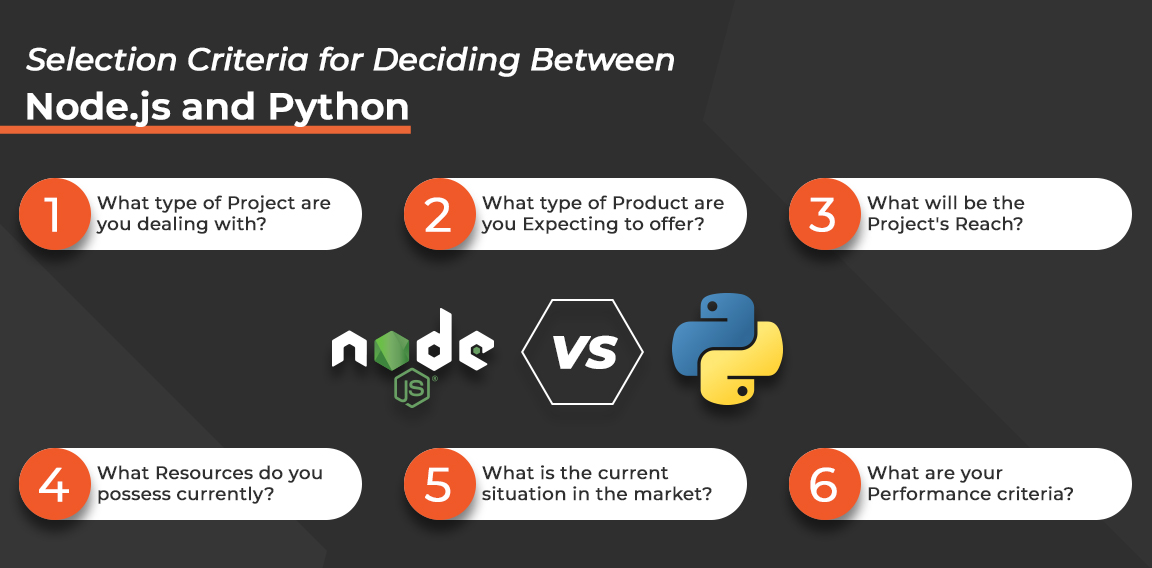
Selection Criteria for Deciding Between Node.js and Python
When you’re looking forward to choosing a perfect backend language for the project, it is the best option to establish the expectations right away. As tech experts for our client, we focus on the following criteria as follows:
Criteria
#1 What type of Project are you dealing with?
The type of project is based on where your project ranges. You have to decide whether your project falls in Computing Apps, Business Apps, Saas, Website, Data-driven software, Social Media App, Messenger App, Gaming App, or any other app.
Your Application or Website will establish the intensity and the nature of backend operation.
#2 What type of Product are you Expecting to offer?
In this, you’ll have to analyze the aim of the product you’re building. You have to know whether your app is a data-heavy app or an interface-focused app? Know whether the functionality of the product is interactive or static?
In this, you will have to analyze your competitor’s strengths and weaknesses, observe the market, and what your users expect.
#3 What will be the Project’s Reach?
When you choose the backend stack for your project, it is very important to understand which user-base you’ll be dealing with – National, Local, or International. More precisely the project’s geographical reach is, more carefully you’ll have to choose architecture, framework, and tech solutions.
#4 What Resources do you possess currently?
Before you start the development of your project, you should know the skill set your team possesses. What technology they have learned and how powerful they are in it? What extra skill sets you’ll require for the development of the Application.
#5 What is the current situation in the market?
Since Covid-19 took over the world, every field in the market raises this question before starting anything. Not only this, but you should know what is the current situation so you can predict the value that your project will serve in the market when it is released.
#6 What are your Performance criteria?
Ideally, you wish for a High-speed, highly-secure, responsive and interactive backend. But no backend development tool is perfect. That’s the fact.
What you can do is set your priorities according to your project needs and choose a tool that focuses on those characteristics.
Now, let’s dig deep and analyze Node.js vs Python in-depth.
Overview of Python
Python is a high-level, interactive interpreted, object-oriented programming. It is designed in such a way that is highly readable. High-level built-in data structures that are merged with dynamic binding and dynamic typing, which makes it very attractive for developing any application faster.
It is simple and easy to learn syntax readability. the modules, libraries, packages encourage code reuse and program modularity. Often, programmers fall in love with python because it increases your productivity and consumes less time to develop code.
Features of Python
Python is called a dynamically typed language because of the ease it provides with coding. It comes with many awesome features that will astonish you to your very core. Those features are:
#1 Easy to code:
Python comes under a high-level programming language. It is very easy to learn compared to other languages, be it C, Javascript, C#, Java, etc. It is a developer-friendly language. Who will not work with fewer lines of code instead of writing huge codes.
#2 Object-Oriented Language:
One of the main and most important features of python is; it is object-oriented programming. Being an object-oriented language it supports objects encapsulation, different concepts of classes, etc.
#3 GUI Support:
You can create Graphical User Interface in python using PyQt5, PyQt4, Tk, or wxPython. Out of all four, the most popular and highly used option for a graphical app using python is PyQt5.
#4 Open Source and Free:
It is available for free on its official website. All you have to do is search for the“Download Python”keyword on Google or any search engine of your choice.
Since it is open-source you can access available source codes according to your need.
#5 Python is Portable:
Python Programming is portable. For example, if you have a code you wrote in windows and you wish to run it on another platform like Mac, Linux, or Unix, you will not have to change the whole code for that. You can run that code on any platform.
#6 Interpreted Language:
Python is an Interpreted language because the code in it is executed line by line like C, Java, C++, etc. In this, you don’t have to compile the code. Thus, Python code makes it easier to debug our code. Its source code is translates into bytecode, which is an immediate representation of the code.
#7 Standard Library:
Language comes with a large standard library that offers a useful set of modules and functions so that you’ll not have to write new code every single time. You can directly use the library and save time.
Advantages and Disadvantages of Python
Overview of Node.js
Node.js or Node is an open-source and cross-platform runtime environment for executing Javascript code outside of a browser. We use this Cross-platform runtime environment quite often to build backend services also called API or Application Programming Interface. Node.js is a highly-scalable, data-intensive, and real-time backend service that powers our client application.
Node is easy to start with, it comes in use for prototyping and agile development. It also comes in use for building super fast and highly scalable services such as PayPal, Uber, Netflix, Walmart, and many more.
Hire best Remote Node.js Developer
Features of Node.js
Features of node.js make it different from other loved programming languages and make it more popular for faster & awesome back end development. Have a look at the awesome Node.js back end development features:
#1 Asynchronous Programming:
Here, event driven IO supports concurrent request handling. Node.js’ APIs are all offbeat. This component specifies that if a Node receives a request for an Input/Output operation, it will perform that task invisibly while planning other solicitations.
#2 Fast Code Execution:
The parser produces an abstract syntax tree when V8 compiles JavaScript code. A syntax tree is a tree representation of JavaScript code’s syntactic structure. Ignition uses this syntax tree, the interpreter, to generate bytecode. TurboFan, the optimizing compiler, eventually converts the bytecode to optimized machine code.
The library of Node. js is quite quick when it comes to executing code. Google Chrome’s V8 JavaScript engine came in use when code was developed.
#3 Highly Scalable and Single-Threaded:
Node.js follows a solitary string model that brings circling of occasion. Node.js follows an event mechanism that can respond by achieving the server very quickly. Since Node.js is non-blocking, all functions (callbacks) go to the event loop, where several threads execute them.
#4 No Buffering:
Applications in Node.js never buff any data. All Applications simply output the data in form of chunks.
Advantages and Disadvantages of Node.js
Differences Between Node.js and Python:
#1 Architecture
Architecture is a place to attach to the framework or language with common practice to achieve the desired output. Here, Python follows a common way of implementation known as “CPython” that uses interchangeable code modules. Where Node.js is a single-threaded architecture that handles multiple requests in a single thread.
The difference between the architecture of Node.js vs Python is:
Node. js
Python
Node.js is a runtime environment with asynchronous programming on the server-side. It means that some processes will be running while the input-output functionality is not blocked. In Node.js, parallel processing can be done such that deploying the application is quick. The event-driven architecture of Node.js allows taking any actions when any event takes place.
Compared to Node.js, Python provides its opposite functionalities. Python is synchronous and supports single threading. In Python, You have to run and finish one whole process. Although, Python does provide libraries like asyncio to make the code asynchronous, using the async/await syntax. asyncio code is an exact fit for high-level and IO-bound structured network code. Where it also provides high-level APIs to perform network IPC and IO; distribution of tasks via queues; keep control over subprocesses; and many more. asyncio may be a single time saver for you but they cannot make python asynchronous to the full extent. It may happen that you may not achieve the desired asynchronicity.
Verdict–
In this, the heads-up goes to Node.js for having asynchronous architecture.
#2 Scalability
The scalability of any language makes us clear about how effective the language is during handling huge user traffic and how it can be managed using fewer servers. Scalability is essential in content-heavy applications and those that serve a diverse set of new users through the use of mobile and desktop interfaces.
Node. js
Python
Node.js is single-threaded and has an asynchronous architecture that is totally based on events and non-blocking I/O that is used to make most of the computer and CPU memory. The asynchronous nature of Node.js makes it more powerful because of its concurrent request execution compared to synchronous/ multi-threaded architecture. In node.js I/O does not block the program execution under I/O heavy workload that helps Node.js application runtime performance all over.
Python being synchronous in nature and supports coroutines. These coroutines can help you achieve asynchronous processing. Python may not seem scalable in nature but it does come with the tools that can help you achieve the desired scalability. Python also weighs well in terms of code complexity, making complex projects easier to code, whereas Node.JS may pose difficulties due to its asynchronous programming.
#3 Libraries
Libraries gave a new base to the whole scenario of app-development technology in the last few decades. If something has already been developed as a code, there should be no need to recreate it. Instead, you can easily integrate this code from libraries to your code/program at the time of development.
Node. js
Python
Node.js is known for its detailed, well-documented, and comprehensive libraries which are managed by Node Package Manager. NPM is called the largest repository in the world because it provides 3,50,000 packages. Ain’t that amazing?
In Python, libraries are managed by pip- ‘Pip Install Packages’ is its acronym. Python libraries are well-documented and easy to deploy. But with the new libraries coming up, it is not well documented as older ones- which makes the new libraries less reliable.
#4 Community
A group of active/current users that works with the new technology. In these technologies, current developers are responsible to keep updating the popular libraries, add new features, and run debugging programs.
A good community is one that is managed by a single dedicated organization that works for a particular programming language.
Node. js
Python
Node.js is not as old as python. It’s true whether you believe it or not. You might consider its community to be strong, but you’d be surprised to know that it has a quite active community of Node.js developers with a large follower base.
Python being the older language has a larger community. The biggest advantage of having a large community and easy to learn syntax is that; you can find the best developer from any corner of the world. A large community means active participation in every python development requirement and these seats are filled by the developers to bring out one happening solution.
Verdict–
Both languages are very popular and are known for the unique ability they possess to make programming easier. Both of them are open-source and free to use.
Here, you need to make the choice of which language’s functionality will suit your project more.
#5 Extensibility
Extensibility refers to the ability of third-party tools to add functionality and perform different functions to an existing software
Let’s take a look at how it will affect Node.js vs Python
Extensibility of Node.js
Extensibility of Python
If you’re using new Node.js, then there is no issue. But, if you’re using an old version of Node.js and you wish to get a smoother front end, it can be achieved by combining Node.js with Babel. For managing the projects, you can use Log.io and for unit-based testing, Jasmin is used. In short, Node.js is very easy and handy.
Python can be made easily extensible using Sublime Text to edit codes in Python. For automated testing, the Robot framework is used. Other than this you might be knowing about these popular Node.js Frameworks like Web2Py and Django which can add a hell lot of features in Python, that are out of your imagination.
Verdict–
To extend the functionalities of both Node.js and Python, you can use a bunch of external frameworks. Both Node.js vs Python works well with external frameworks.
Node.js vs Python: Use Cases
Node.js vs Python: both areas of applications are quite different in their own ways. Python rules over the world because it provides server-side language, but on the same side, Node.js is a go-to tool for every business.
Let’s Dig a little deeper to understand, Node.js vs Python, which is worth considering for web application development.
Use Cases of Node.js
It is a runtime environment that is an ideal choice for apps that uses a constant connection between server and web application.
Node.js has quite good Use cases like:
Use Cases of Node.js
#1 Microservice Architecture
Microservice Architecture is a method of designing a web application in a small community that is divided into separate services, each of which performs a specific purpose. Microservice architecture web application communicates through REST/HTTP protocol with the help of JSON Data Structure.
#2 For Creating SPAs (Single Page Application)
SPAs have become a very common approach today. In SPA the whole page basically fits on one page to offer a desktop app-like experience. Node.js is perfect for building SPA because its asynchronous nature deals with heavy I/O operations.
#3 Chatbots
You might already know that chatbots are already in use on a wide range these days. In fact, it has become a necessity for every single business. NodeJS comes with all the basic functionalities for building chatbots. Node Event API is very helpful for developers because it makes it possible to implement server-side events.
#4 Streaming Web Apps
NodeJS is the best choice for the development of streaming web apps. Node.js comes with a built-in interface for readable and writable streams that can be processed efficiently and monitored perfectly.
#5 Server-Side Applications
Since user behaviour, messages, and unique events of this kind define the flow, Node.js is a server-side application.
Use Cases of Python
Python is an excellent option for website development in businesses. It is a powerful language for applications and websites. It is data-intensive and easy to learn.
Let’s take a look at the use cases of Python:
Use Cases of Python
#1 Data Analysis
Data Analysis is now reaching heights. It is becoming one of the most important areas of development with applications of Python Programming. Python provides many libraries for Big Data Analysis like NumPy, Pandas, SciPy, and many more to work with data and extract it.
Here or there, Python is the best fit forBig Data.
#2 Web App Development
One of the best uses of Python in Website Development. It is simply the best option and go-to programming language for web applications. Python provides Convenience, security, and scalability on the web app. Python offers a lot of website development frameworks like Flask and Django which are very efficient in their own ways.
In 2021, Python for Startup is the best choice because the ease it provides with web development, gives python a heads up for being a highly chosen back end development framework.
#3 Programming of Web Scraper
Web Scraping for a huge amount of data has become a useful medium for every business for extracting customer information and making a better and smart decision for the future.
#4 Machine Learning & Artificial Intelligence
The most interesting use of Python in Machine Learning & Artificial Intelligence. Machine Learning algorithms are the most important real-life uses of Python. Using the Python programming language, Developers can easily make a program in fewer lines of code with the best output.
#5 Educational Purpose
Since the businesses on large scale have started their development on Python, Python has made its space in schools and universities, as the main subject. It is widely accepted due to its user-friendly programming, plain syntax, extensive tools, and straightforward learning curve. Because python allows for the advancement of both advanced and basic educational programmes.
Final Verdict
Choosing between Node.js and Python can be one flinty job especially when you’re looking forward to developing a fully-functionalized project or product. As you saw, both platforms work best for web development or back-end development.
The features and benefits of both platforms are overwhelming and can confuse you. All you need to keep in mind is that you should keep your choices clear according to your project needs. In the end, the runtime environment that is more feasible and handy should be your first choice. Hopefully, this article will give you a clear perspective about both Node.js and Python, what it is, what are their features, advantages, disadvantages, and use cases. If you need help with analyzing your project, you can contact our team, we will help you analyze your business and suggest to you the best backend tool that will meet your users and your expectations.
Hire Developer
Tell us what you need, and we’ll match you with the perfect developer.